
If you are still relying on long-winded, poetic paragraphs to sell your Airbnb listing, your search visibility is likely taking a hit.
Following the massive platform shifts from the Airbnb 2026 Summer Release, the discovery funnel has fundamentally changed. Travelers aren't just scrolling through a uniform page anymore; instead, Airbnb's backend engine is completely personalizing how your home is presented to every individual user.
Here is why your old description strategy is obsolete, and how to format your listing data to feed the 2026 AI discovery engine.
1. Every Guest Sees a Different Version of Your Home
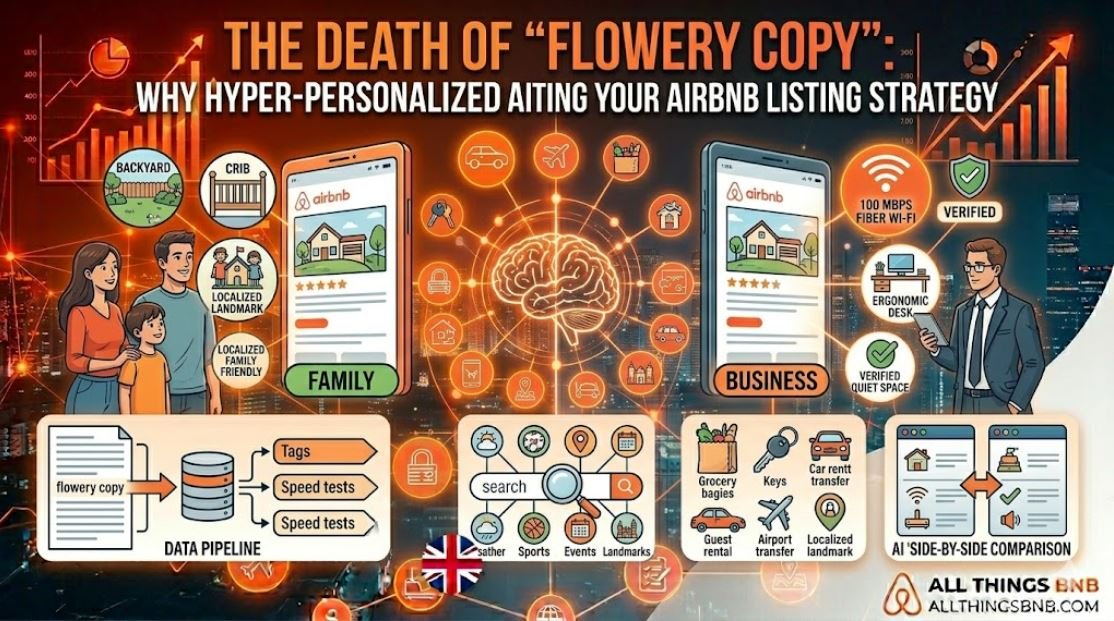
The headline shift of the latest ecosystem update is Personalized Listing Highlights. Airbnb’s internal AI now dynamically restructures the information displayed on your listing page based on who is looking at it.
-
For Families: The AI frontloads your child-safety amenities, crib availability, yard details, and nearby family spots.
-
For Remote Workers: The system surfaces your dedicated workspace tag, verified Wi-Fi speed, and quiet hours.
-
For Foodies: The interface highlights your close proximity to local food markets and highly-rated restaurants.
The Reality Check: The machine learning algorithm isn't reading between the lines of your paragraphs to deduce these details. It checks explicit tags, backend data fields, and structured attributes. If you have a specific feature but haven’t explicitly tagged it in your settings, the AI cannot surface it to the right target audience.
2. The Power of "Ask About This Home"
A major feature introduced this summer is the "Ask about this home" natural language search bar right on your listing page. Instead of hunting through text, guests can type direct questions like, "Is the workspace quiet enough for video calls?" or "Can the kitchen handle cooking a full family dinner?"
The AI answers these questions instantly by scanning your photos, location coordinates, checked amenities, and historical guest reviews. If your structured details are sparse or inconsistent, the AI won't be able to give a confident answer, and the guest will move on to a competitor.
3. How to Optimize Your Listing Layout for 2026
To win both the algorithmic sorting match and capture human attention spans, your copy needs to drop the fluff and pivot to clean, scannable data. Structure your listing content around this rigid template:
-
The Hook (Lines 1-2): Put your property's absolute strongest unique selling point directly at the top where it can’t be missed.
-
The Technical Amenities: Do not just check the box for Wi-Fi—input exact speeds (e.g., "100 Mbps fiber Wi-Fi") and name specific workspace setups.
-
Spatial Layout: Provide a highly structured, bulleted breakdown of the floor plan so guests can instantly visualize group dynamics.
-
Radical Transparency: If there's an quirk (like street noise or low ceilings), state it directly. The AI cross-references your text with AI Review Highlights, and hiding an issue will penalize your ranking if guest reviews call it out later.
4. Leverage the Expanded Super-App Services
Because Airbnb is transforming into a comprehensive trip operating system, listings are no longer isolated options—they are now presented alongside Instacart grocery pre-stocking, Welcome Pickups airport transfers, and localized experience maps.
Make sure your check-in instructions and listing details tie into these tools. Mentioning that your space supports seamless arrival logistics keeps you aligned with the exact type of convenience-focused booking patterns the platform is actively rewarding this season.
For the featured graphic on this post, we recommend a text-less visual showcasing a split-screen layout: on one side, a family viewing a listing highlighted with backyards and crib icons; on the other side, a business traveler viewing the exact same home but with Wi-Fi speeds and workspace metrics illuminated, capturing the dynamic nature of personalized AI search.