
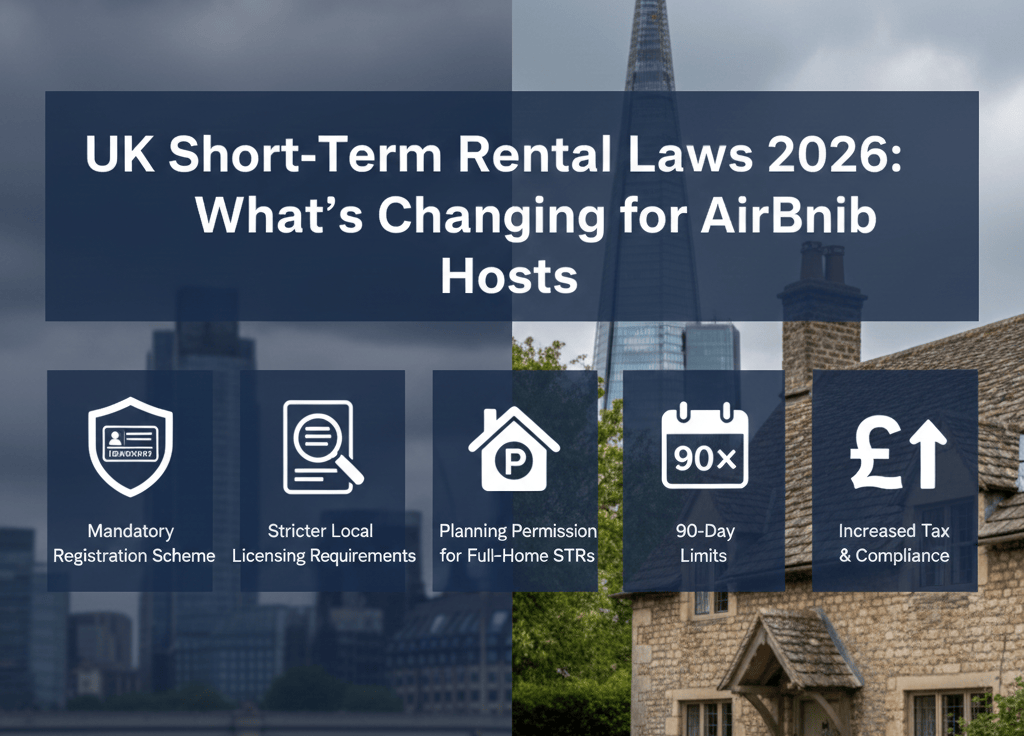
The UK short-term rental sector is heading toward one of its biggest regulatory shifts in years. With new rules expected to take effect by 2026, Airbnb hosts across England, Scotland, Wales, and Northern Ireland will need to prepare for updated licensing systems, planning permissions, registration schemes, and compliance checks.
These changes are designed to increase transparency, protect housing availability for locals, and ensure that short-term lets operate to consistent standards nationwide.
Here’s a clear breakdown of what UK hosts can expect as the new 2026 rules take shape.
1. Mandatory National Registration Scheme
From 2026, the UK Government is expected to roll out a national short-term let registration system.
This means:
-
Every Airbnb or short-term rental will need a unique registration number
-
Hosts must submit basic property information (address, capacity, host details)
-
Councils will gain access to local STR data for better oversight
-
Platforms like Airbnb will be required to display registration numbers publicly
The goal is to create a transparent database of holiday lets — particularly in cities where STRs heavily impact housing availability.
2. Stricter Local Licensing Requirements
Local licensing rules are set to tighten, especially in high-pressure areas such as:
-
London
-
Edinburgh
-
Bristol
-
Manchester
-
Brighton
-
Holiday towns and coastal hotspots
Councils will have greater authority to require:
-
Compulsory short-term let licences
-
Health & safety checks
-
Operational standards (fire safety, insurance, waste management, occupancy rules)
-
Renewal every 1–3 years
This mirrors the Scottish licensing model introduced previously but is expected to be more uniform across the UK by 2026.
3. Planning Permission for Full-Home STRs
One of the biggest proposed changes is a new planning category for short-term lets.
Hosts offering entire-property rentals (not home-sharing) may soon need:
-
Planning permission to operate legally
-
Approval for change of use to a “short-term let” classification
-
Compliance with neighbourhood density rules
This could especially impact:
-
Apartment blocks
-
Multi-unit buildings
-
Central city zones
-
Tourist-heavy regions
Some councils might impose caps on STR numbers or designate “control areas” where holiday lets are restricted.
4. 90-Day Limits Likely to Expand Beyond London
London currently has the well-known 90-day annual cap for entire-home STRs unless planning permission is granted.
By 2026, similar limits may roll out to:
-
Edinburgh
-
Bath
-
Oxford
-
York
-
Cambridge
-
Some rural hotspots under housing pressure
Hosts should expect annual night caps or seasonal restrictions in certain zones.
5. Increased Tax Reporting & Compliance
With better data collection through registration, HMRC is expected to tighten tax oversight, including:
-
Automatic reporting of host income from platforms
-
Simplified UK-wide tax rules for STR businesses
-
Possible changes to current reliefs (Furnished Holiday Lets, mortgage interest rules, etc.)
Hosts will need to ensure:
-
Accurate bookkeeping
-
Annual self-assessment submissions
-
Compliance with updated income thresholds
6. Enhanced Guest Safety Standards
Safety compliance is expected to become more standardised. Hosts may be required to provide:
-
Fire risk assessments
-
Carbon monoxide alarms
-
Evidence of electrical & gas safety checks
-
Clear emergency instructions
-
Insurance proof
More councils are expected to carry out spot inspections to ensure compliance with licensing conditions.
7. Clearer Rules on Anti-Social Behaviour
Airbnb hosts will face stricter expectations regarding:
-
Noise monitoring
-
Neighbour complaints
-
Large group bookings
-
House party prevention
Councils may require contingency plans such as:
-
Noise sensors
-
24/7 host contact numbers
-
Guest identity verification
This is part of a national effort to reduce issues in residential areas.
What UK Airbnb Hosts Should Do Now
While 2026 may feel far off, hosts can start preparing early:
✓ Review local council consultations
Many councils are already shaping their 2026 policies.
✓ Prepare documentation
Safety certificates, insurance updates, and property details will soon be required for registration.
✓ Watch for planning changes
If you're offering entire-home stays, planning rules could impact future operations.
✓ Upgrade your listing standards
Regulations will favour compliant, well-managed properties.
✓ Follow AllthingsBNB for ongoing updates
The new STR framework will continue evolving throughout 2025 — and we’ll keep hosts informed as new details emerge.
Final Thoughts
The 2026 short-term rental reforms mark a major step in regulating the UK’s fast-growing STR market. While the changes may seem strict, they also create a more stable, transparent, and professional environment for responsible Airbnb hosts.
Staying informed and preparing ahead of time will help hosts continue operating smoothly — and even gain an advantage as the industry becomes more regulated.