
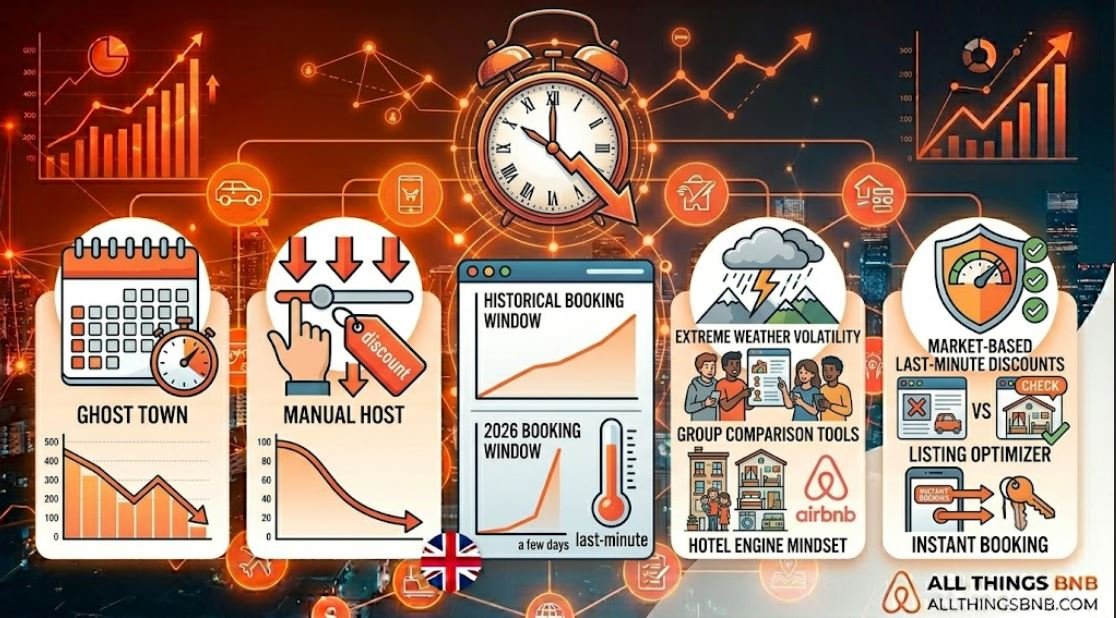
If you look at your calendar for next month and feel a sudden wave of anxiety because half your dates are still wide open, you are not alone. Across the UK and global markets, thousands of professional hosts are staring at empty booking pipelines and asking the exact same question: Where did all the travelers go?
But the data tells a completely different story. Travelers haven't stopped booking; they’ve simply stopped booking in advance.
According to major 2026 market intelligence reports from PriceLabs and AirDNA, the short-term rental industry has officially collided with a massive behavioral shift: the compression of the booking window. Guests are waiting longer than ever to pull the trigger on their stays, and hosts who don't understand the mathematics behind this trend are falling straight into the lucrative "7-Day Panic" trap.
At All Things BNB, we look past the surface panic to look at the raw data. Here is the operational breakdown of why the booking window has shrunk, and how you can protect your Average Daily Rate (ADR) without tanking your revenue.
1. The Data Breakdown: The Shinking Booking Window
The historical luxury of looking at a fully locked-in summer calendar three months ahead of time is officially over. Traveler behavior has normalized into a hyper-fluid, spontaneous pattern.
Look at how the average time between booking and arrival has compressed over the last few years:
| Stay Season | 2022 Average Window | 2026 Average Window |
| January Winter Stays | 19 Days | 15 Days |
| July Peak Summer Stays | 34 Days | 29 Days |
Even more staggering? Last-minute bookings made within 0 to 7 days of arrival now account for a massive 27% of all reservations globally. More than a quarter of your entire potential market is choosing their accommodation the exact same week they travel.
2. What Causes the "7-Day Panic" Trap?
When a host operates on gut feeling rather than hyper-local data, an open calendar 14 days out looks like an emergency. The sequence almost always plays out the exact same way:
-
The Ghost Town Effect: The calendar is empty two weeks before a prime summer weekend.
-
The Panic Drop: Out of fear of zero occupancy, the host manually overrides their system and slashes their nightly rate by 30% or 40%.
-
The Instant Fill: A last-minute traveler snaps up the property within 48 hours.
-
The Lost Revenue: The host celebrates the booking, entirely unaware that the guest would have paid full market price if the rate had stayed steady for just 5 more days.
By slashing prices prematurely, you aren't creating demand—you are simply giving away your hard-earned premium margin to a traveler who was already planning to book last-minute.
3. Why are Guests Waiting Until the Last Minute?
This isn't a random glitch; it's a structural evolution in consumer habits driven by three major factors:
Extreme Weather Volatility
Following unpredictable seasonal weather patterns over the last two years, travelers are terrified of locking in non-refundable mountain, coastal, or rural retreat trips months in advance only to face unexpected conditions. They check the local 7-day forecast first, and then they open the Airbnb app.
The Rise of App-Driven Comparison
With Airbnb’s major 2026 Summer Release introducing advanced AI-powered comparison tools, guests can save multiple homes to a single shared itinerary, instantly contrast structured amenities, and monitor pricing changes in real-time. The app makes it incredibly easy for groups and solo travelers to sit on their options until the absolute last moment.
The "Hotel Alternative" Mindset
As Airbnb integrates thousands of boutique and independent hotels natively into its search results, guests are treating the platform like a traditional hotel engine. They expect the exact same last-minute inventory availability that hotels have offered for decades.
4. The Defensive Playbook: How to Hold Your Ground
To survive and maximize your Revenue Per Available Room (RevPAR) in this condensed market, you must transition from reactive panic to systematic data management.
Pivot to Market-Based Last-Minute Discounts
Never use a flat, static percentage discount for last-minute dates. Ensure your dynamic pricing software is set to Market-Based Adjustments. If the entire hyper-local market around your listing is experiencing a slow booking window, your system will automatically scale down your pricing incrementally based on real-time competitor supply—not out of blind panic.
Fix the Content "Quality Gap"
When a guest is booking a trip for this weekend, they do not have time to message you back and forth to clarify details. They choose the listing that gives them absolute certainty.
An extensive audit of over 10,000 listings revealed that 70% of properties have weak or confusing photos, and 40% feature listing inconsistencies (like a property tagged as a dedicated workspace but showing no desk in the photos). Use a listing optimizer tool to guarantee your titles, photo captions, and amenities are flawlessly accurate.
Emphasize Instant Booking and Seamless Access
If your listing requires a manual booking approval step, you are completely locking yourself out of the 27% last-minute traveler pool. Turn on Instant Book, highlight your secure smart lock integration in your primary photo captions, and state explicitly that check-in details are sent automatically the moment the booking is confirmed.
📌 The Bottom Line
A vacant calendar two weeks out is no longer a sign of a failing listing; it is simply the new operational baseline of the experience economy. The hosts who dominate the short-term rental market are those who treat their rentals like a professional hospitality business—holding their nerve, trusting the algorithmic pricing rails, and ensuring their structured data is so compelling that the last-minute seeker has no choice but to book.
Master the 2026 Revenue Landscape
Don't let compressed windows eat into your bottom line. From local market dashboards to advanced SEO and pricing frameworks designed to capture high-intent travelers, protect your investment portfolio with elite tools. Visit allthingsbnb.com.
How has your property's average booking window shifted this season? Are you holding your rates steady or using automated discount curves? Let's swap notes in the comments below!