
For years, the short-term rental (STR) market felt like an unstoppable gold rush. Anyone with a spare room, a generic design template, and an automated lock could throw up a listing and secure consistent bookings.
But as we cross the midpoint of 2026, a quiet stabilization has hit the industry. The national average occupancy rate has officially normalized and stabilized near 50% (down from its post-pandemic highs of ~57%). The post-COVID overbuilding wave has slowed, and the market is rapidly finding a mature equilibrium.
Yet, headlines claiming "the death of short-term rentals" are completely missing the real story. Average Daily Rates (ADRs) remain incredibly resilient, growing steadily at 1-2% annually, while Revenue Per Available Room (RevPAR) is actually up a healthy 8.1% year-over-year.
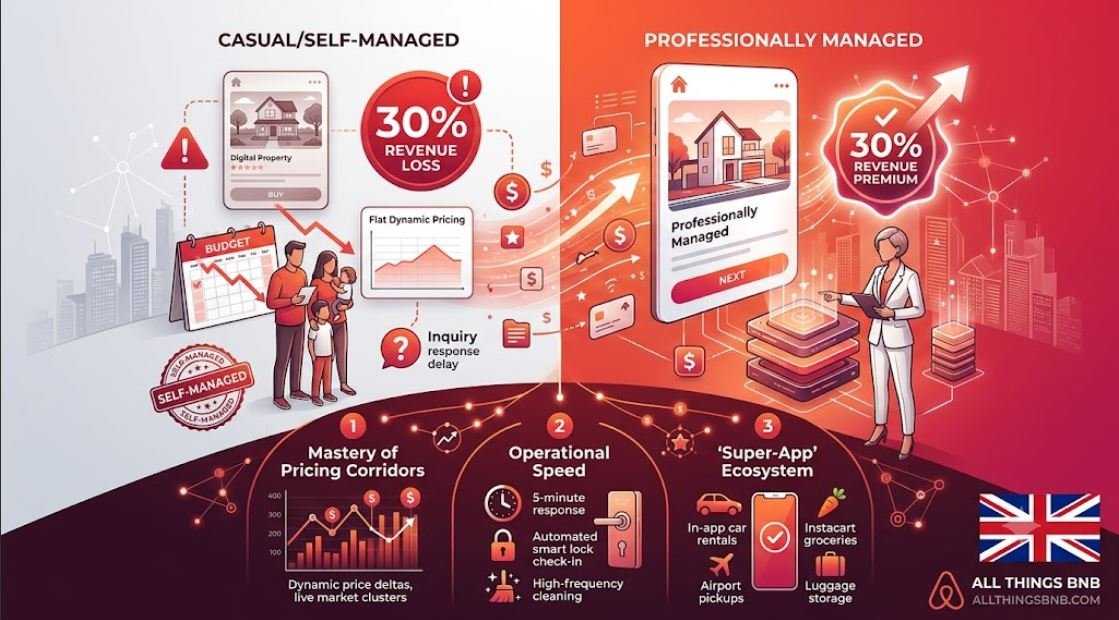
The wealth hasn't disappeared—it has shifted. Real-time market data reveals a massive performance gap: professionally managed listings are currently out-earning self-managed, casual properties by an impressive 20% to 30%.
We are living through The Great STR Reset. Here are the three pillars driving this massive professional revenue premium in 2026, and how independent hosts can bridge the gap.
1. The Mastery of Dynamic Pricing Corridors
The days of setting a flat "weekend rate" and "weekday rate" and leaving it on autopilot for six months are over. Casual hosts often panic when they see a block of unbooked days two weeks out, leading them to aggressively slash prices and tank their margins.
Professional operators use advanced dynamic pricing algorithms and free market intelligence tools to protect their yields.
  [ Casual Approach ]   ──► Set Static Rate ──► Unbooked Block ──► Panic Price Drop (Loss)

  [ Professional ]       ──► Live Market     ──► Micro-Adjust   ──► Max-Yield Booking
                        Data Overlay        Pricing Corridor      (Retained Margin)
Instead of guessing, professionals map their portfolio directly against competitive local clusters. If data shows a massive demand catalyst on the horizon—like the upcoming FIFA World Cup 2026 shifts hitting major host cities—they hold their premium pricing corridors early. They let real-time pacing data dictate micro-adjustments rather than emotional instinct.
2. Operational Speed is the Ultimate Conversion Signal
Airbnb’s ranking algorithm now tracks operational metrics with extreme precision to determine search visibility. The modern platform backend favors absolute consistency.
-
The 5-Minute Inquiry Rule: Data consistently shows that operators who respond to guest inquiries within five minutes have a exponentially higher conversion rate. Professional teams utilize unified communication hubs and integrated Property Management Systems (PMS) to ensure no message sits unanswered.
-
Frictionless High-Frequency Turnovers: With Gen Z shifting heavily toward rapid, 48-hour "micro-trips," properties are experiencing much higher turnover frequencies. Professional managers handle this bottleneck seamlessly by automating check-ins and using task-based, synced cleaning schedules. If a casual host takes hours to approve a stay or coordinate a key drop, the modern high-velocity traveler has already booked a competitor.
3. Capitalizing on the "Super-App" Ecosystem
Following the landmark Airbnb 2026 Summer Release, the platform has officially transitioned from a simple listing directory into a full-scale travel lifestyle ecosystem. Stays are now natively integrated with third-party local logistics: airport pickups via Welcome Pickups, luggage storage via Bounce, and grocery deliveries via Instacart.
                 ┌─► In-App Grocery Pre-Stocking (Instacart)
                 ├─► Curated Food Culture Experiences
[ Airbnb 2026 ] ─┼─► Airport Pickups (Welcome Pickups)
                 ├─► Luggage Storage Options (Bounce)
                 └─► In-App Car Rentals
Professionals look at these updates as massive high-margin hospitality opportunities. For example, in select markets, hosts can opt-in to receive and pre-stock a guest's grocery order before they cross the threshold.
By leaning heavily into these platform integrations, professional operators elevate a basic accommodation into a frictionless, five-star luxury arrival. The algorithm rewards this behavioral alignment by pushing these highly integrated listings directly to the top of the search funnel.
The Bottom Line for 2026
The short-term rental market is no longer a hobbyist's playground; it is an analytical, hospitality-first discipline. The 30% revenue premium earned by professionals isn't due to luck—it is the direct result of treating every listing as a high-performance digital asset.
To protect your margins and scale your calendar this year, you must trade gut feel for real-time analytics, automate your operational bottlenecks, and embrace the platform's new service-driven ecosystem.
Are you noticing an increase in shorter, high-frequency "micro-trips" in your local market this season, or are you primarily hosting longer-term stays?