
If you’ve been running an Airbnb in the UK as a casual side hustle, 2026 is officially the year you have to stop "winging it."
Between the taxman gaining digital superpowers and local councils receiving unprecedented regulatory teeth, the UK short-term rental market is undergoing its biggest structural shakeup in a decade. The era of passive, unregulated holiday letting is dead—but for professional, organized operators, this is a massive opportunity to clear out the amateurs and dominate the local market.
At All Things BNB, we’ve parsed through the latest HMRC rules and government frameworks to give you the non-negotiable compliance checklist you need to survive this year.
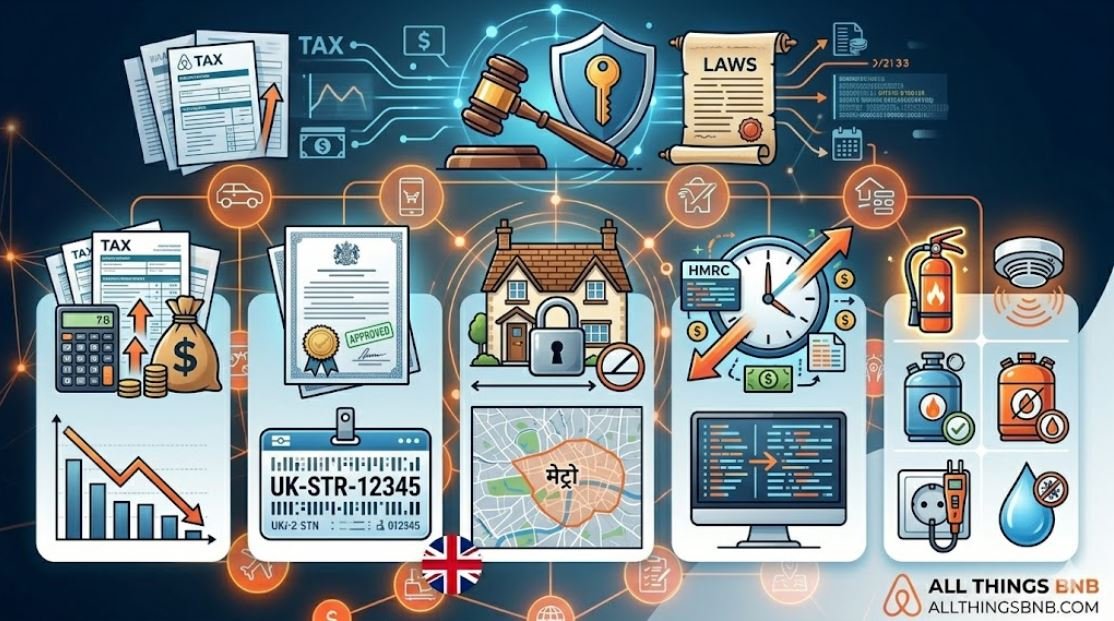
1. The Death of the FHL Tax Regime (The Tax Squeeze)
The biggest financial blow to hosts this year is the full enforcement of the abolition of the Furnished Holiday Letting (FHL) tax regime. Short-term let income is now officially taxed as standard property business income.
-
The Mortgage Interest Trap: For higher-rate taxpayers, you can no longer deduct mortgage interest directly from your rental income before calculating tax.
-
Slashed Capital Allowances: You can no longer claim business capital allowances on new expenditure for furniture, fixtures, and equipment. Instead, you must rely on the less generous "replacement of domestic items" relief.
-
The Strategy: Because profits are now taxed strictly at your marginal income tax rate, many professional hosts are moving their portfolios into a Limited Company structure to protect their margins.
2. Mandatory National Registration is Here
The Department for Levelling Up, Housing and Communities (DLUHC) has officially introduced the mandatory national registration scheme for all short-term lets in England.
-
No ID, No Listing: Every single host must register their property on a government register, submitting up-to-date safety compliance documentation and proof of insurance.
-
The Unique Number: Once approved, you receive a unique registration number. Platforms like Airbnb, Booking.com, and Vrbo are now legally required to display this number on your listing and must automatically remove any unregistered properties.
-
The Penalty: Operating an unregistered property carries severe civil penalties, with fines starting at up to £5,000 for a first offense.
3. The C5 Planning Use Class & Local Caps
To separate short-term rentals from standard housing stock, the government has introduced the C5 planning use class specifically for short-term lets.
-
Article 4 Directions: While London enforces its strict, multi-platform 90-night annual limit for entire-home listings, local councils outside the capital now have the explicit power to require full planning permission to switch a home from residential (C3) to holiday let (C5).
-
The Challenge: If you are running an accessory dwelling unit or a self-contained annex as a year-round Airbnb, local councils are increasingly viewing this as a "material change of use" requiring active planning consent.
4. Total HMRC Data Transparency (The "Side-Hustle" Crackdown)
If you think HMRC won't notice your occasional rental income, think again. Under global digital platform reporting rules fully active this year, Airbnb is legally mandated to share your top-line revenue, transaction history, and banking data directly with tax authorities in real-time.
-
Automatic Auditing: HMRC is actively matching Airbnb data dumps against individual Self Assessment tax returns. Enquiries into short-let income have spiked by over 30%.
-
The Action: Keep meticulous independent digital records of your cleaning costs, utilities, platform fees, and guest subscriptions. If your gross annual property income is over the £1,000 property allowance, you must declare it.
5. Non-Negotiable Mandatory Safety Checks
With increased regulatory oversight comes strict health and safety enforcement. Local authorities now have direct powers to conduct spot-checks on holiday lets. To avoid massive fines or listing suspensions, your property must possess:
| Requirement | Compliance Standard |
| Gas Safety | Valid certificate issued by a Gas Safe engineer, renewed annually. |
| Electrical Safety | An Electrical Installation Condition Report (EICR). |
| Fire Safety | A written Fire Risk Assessment, smoke alarms on every floor, and fully compliant fire-retardant furnishings. |
| Water Safety | A completed Legionella risk assessment. |
📌 The Bottom Line: Adapt or Exit
Tighter regulation is triggering a mass professionalization of the Airbnb marketplace. Part-time hosts who aren't willing to manage the administrative, legal, and fiscal complexities of 2026 are exiting the market entirely.
For dedicated operators, this means less supply and higher premium nightly rates. If you treat your Airbnb like a legitimate hospitality business, ensure your compliance is bulletproof—because a compliant listing is the ultimate competitive edge this summer.
Keep Your Business Compliant
Don't let a surprise council notice or tax penalty ruin your season. From dynamic revenue management under night caps to complete tax optimization strategies, find your professional host toolkit at allthingsbnb.com.
Have you successfully secured your registration number for the summer rush yet?